Binary search finds a transition in a monotone decision by discarding half of the remaining range at each step. Searching a sorted array is only one example. Its correctness depends on a proved monotonicity property rather than on the fact that a midpoint is calculated [1].
Define the contract#
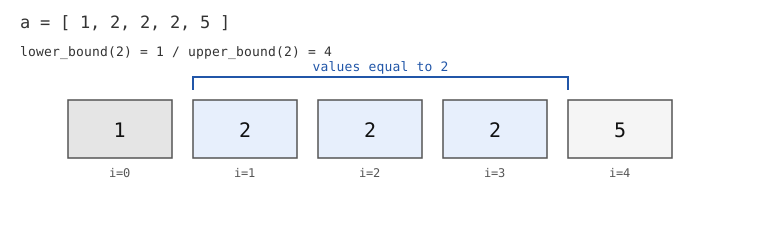
Let a be an array of n comparable elements in nondecreasing order. The lower bound of x is the first position i such that a[i] is at least x, or n if none exists. The upper bound is the first position whose value is strictly greater than x. They are insertion points, not necessarily matches. In [1, 2, 2, 2, 5], lower bound of 2 is 1 and upper bound is 4; the number of occurrences equals 4 minus 1 [2].
Define predicate P(i) to be true exactly when a[i] is at least x. Sorting produces a sequence of zero or more false values followed by zero or more true values. Maintain an interval [lo, hi] of possible answers, initially [0,n], where n is the sentinel for no match. At each iteration, examine mid in [lo,hi). If a[mid] is less than x, every earlier element is too small, so set lo=mid+1. Otherwise the answer is no later than mid, so set hi=mid. Thus the answer remains inside [lo,hi] after every iteration [1].
Implementation and verification#
def lower_bound(a, x):
    lo, hi = 0, len(a)
    while lo < hi:
        mid = lo + (hi - lo) // 2
        if a[mid] < x:
            lo = mid + 1
        else:
            hi = mid
    return lo

def upper_bound(a, x):
    lo, hi = 0, len(a)
    while lo < hi:
        mid = lo + (hi - lo) // 2
        if a[mid] <= x:
            lo = mid + 1
        else:
            hi = mid
    return lo

a = [1, 2, 2, 2, 5]
assert (lower_bound(a, 2), upper_bound(a, 2)) == (1, 4)
assert lower_bound(a, 3) == 4
assert lower_bound([], 7) == 0
assert lower_bound(a, 9) == len(a)
Proof: Initially the answer belongs to [0,n]. A decision at mid discards only candidates that are impossible by the sortedness assumption. Whenever lo < hi, the interval length decreases strictly, so termination follows. At termination lo=hi is the smallest position satisfying the predicate, or n. This gives a correctness proof for all valid input arrays, not merely the examples.
Complexity and alternatives#
After k iterations at most approximately n/2^k candidate positions remain. Therefore time is O(log(n+1)) and additional space is O(1), assuming random-access indexing and constant-time comparisons. On linked lists, reaching the midpoint itself can be expensive. Using lo+(hi-lo)//2 avoids adding two potentially overflowing positive indices in fixed-width integer languages; Python integers do not overflow that way [1].
| Array | Lower bound of 2 | Upper bound of 2 |
|---|---|---|
| Empty | 0 | 0 |
| [2] | 0 | 1 |
| [1,2,2,5] | 1 | 3 |
| [3,4] | 0 | 0 |
For a minimum-feasible-capacity question, define P(capacity) as whether a solution exists. If feasibility changes exactly once from false to true over a finite integer range, binary search also works. With R possible integer answers and a feasibility test costing C, the complexity is O(C log R). If feasibility oscillates, the approach is incorrect even when each individual test is reliable. Searching for a position is logarithmic, but inserting into a Python list still shifts elements in O(n) time [2].
Failure modes and applicability#
Unsorted data, nonmonotone predicates, concurrently modified sequences, inconsistent comparators, and unspecified duplicate handling invalidate the reasoning. A hash table can be preferable for many independent key lookups; for a tiny unsorted list, linear scan can be cheaper than sorting. The Python bisect documentation also warns against concurrent mutations during bisection [2].
A fully explicit loop invariant#
Think of the answer as a boundary in a boolean sequence P(0),...,P(n-1), with all false values before all true values. Maintain [lo,hi) with 0≤lo≤hi≤n, where every index below lo is already known false and every index at or above hi is known true (with n a virtual true sentinel). Initially lo=0,hi=n; there are no excluded indices. For midpoint mid, if P(mid) is false, monotonicity excludes 0..mid, so lo=mid+1. Otherwise mid..n-1 is true and hi=mid. At termination the boundary must equal lo=hi [1]. This proves partial correctness; strict shrinking of hi-lo proves termination.
Capacity search: a complete derivation#
Consider positive integer jobs processed in order and divided into at most d days. Jobs within one day must be contiguous and indivisible. The minimum daily capacity lies in [max(jobs), sum(jobs)]. For a fixed capacity C, greedily filling each day with as many consecutive jobs as possible minimizes the number of days: ending a day earlier cannot process a longer prefix. Hence, if C is feasible, every larger capacity is feasible [1].
def minimum_capacity(jobs, days):
    if not jobs or days < 1 or any(job <= 0 for job in jobs):
        raise ValueError("positive jobs and days >= 1 required")
    def feasible(capacity):
        used, load = 1, 0
        for job in jobs:
            if load + job > capacity:
                used += 1
                load = 0
            load += job
        return used <= days

    lo, hi = max(jobs), sum(jobs)
    while lo < hi:
        mid = lo + (hi - lo) // 2
        if feasible(mid):
            hi = mid
        else:
            lo = mid + 1
    return lo

assert minimum_capacity([7, 2, 5, 10, 8], 2) == 18
assert minimum_capacity([7, 2, 5, 10, 8], 3) == 14
assert minimum_capacity([1, 1, 1], 2) == 2
assert minimum_capacity([9], 4) == 9
The smallest feasible value stays within [lo, hi], since monotonicity discards only impossible candidates at each step, and the interval strictly shrinks. For n jobs and R = sum(jobs)-max(jobs)+1 candidate integer capacities, time is O(n log(R+1)) and extra space O(1) under constant-cost arithmetic. The proof has two obligations: the greedy check correctly decides feasibility, and feasibility is monotone. A correct outer search cannot repair a faulty check.
Arithmetic and real-world constraints#
When an indexed collection changes concurrently, even perfectly written loop bounds cannot guarantee results: the monotonic premise may disappear during the search. In fixed-width languages, compute mid=lo+(hi-lo)//2 to avoid overflow from lo+hi. In Python, indices are arbitrary precision but list operations still have costs. An insertion index located in O(log n) on an array does not make inserting an element logarithmic: shifting elements may cost O(n) [2].
Additional edge-case tests#
from bisect import bisect_left, bisect_right
for xs in ([], [2], [2,2,2], [1,3,4,8]):
    for key in (-1,0,1,2,3,5,9):
        assert lower_bound(xs,key) == bisect_left(xs,key)
        assert upper_bound(xs,key) == bisect_right(xs,key)
The tests above extend the earlier definitions in this chapter; execute both code blocks in the same Python session. Include duplicates, missing keys, the empty input and values outside both extremes. For an unsorted array, do not blame the implementation when it produces a wrong answer: the input violated the contract.
Exercises and verification#
- Trace lower bound of 4 in [1,2,2,5]: examine index 2 (value 2), then index 3 (value 5); the answer is 3.
- Explain why P(i) = (a[i] equals x) is not monotone even for sorted data: it may be false, true, and false again.
- Verify the implementation against Python bisect_left and bisect_right on empty, repeated, and out-of-range cases.
- Invent a capacity predicate, prove its monotonicity, and count the maximum number of evaluations for R=1,024.