Low-Level Design (LLD) translates product rules into components, interfaces, data structures and permitted state transitions. It is neither a contest to use as many design patterns as possible nor simply drawing a UML class diagram. A design is useful if another engineer can derive its contracts, implement behavior and change it without violating the system's critical invariants [1][2].
Turn requirements into invariants first#
Consider a reservation service. A booking may be pending, confirmed or cancelled. A confirmed booking must not return to pending. Cancellation is terminal under this example's business contract. The identifier never changes after creation. Valid transitions are pending→confirmed, pending→cancelled and confirmed→cancelled. There is no transition cancelled→confirmed; rebooking creates a new reservation. Another business could choose different rules, but those must be explicit before deciding class names.
Distinguish invariant ('a cancelled reservation cannot be confirmed') from workflow ('the API checks inventory, then reserves'). A class can enforce local state transitions, but a shared seat's global uniqueness across processes belongs in a transactional database or another authoritative coordination mechanism. A local object cannot lock a distributed seat simply because its method is called reserve().
Model the state machine explicitly#
Use a diagram before implementation so reviewers can challenge missing transitions. A transition requires a starting state, an event, preconditions, a resulting state and an error policy when invalid. Decide whether retrying cancellation is a no-op (idempotent) or produces an error; both policies are possible, but ambiguity makes clients unreliable.
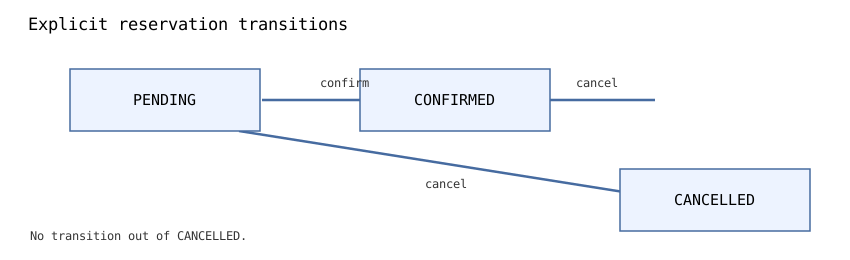
A reproducible implementation with narrow responsibilities#
from enum import Enum, auto

class Status(Enum):
    PENDING = auto()
    CONFIRMED = auto()
    CANCELLED = auto()

class Reservation:
    def __init__(self, identifier):
        if not identifier:
            raise ValueError("identifier is required")
        self._id = identifier
        self._status = Status.PENDING

    @property
    def status(self):
        return self._status

    @property
    def identifier(self):
        return self._id

    def confirm(self):
        if self._status != Status.PENDING:
            raise ValueError("only pending reservations can be confirmed")
        self._status = Status.CONFIRMED

    def cancel(self):
        if self._status == Status.CANCELLED:
            return False  # idempotent cancellation
        self._status = Status.CANCELLED
        return True

booking = Reservation("R-1")
assert booking.status == Status.PENDING
booking.confirm()
assert booking.status == Status.CONFIRMED
assert booking.cancel()
assert not booking.cancel()
try:
    booking.confirm()
    assert False
except ValueError:
    pass
The example is deliberately in-memory. It handles one object, no concurrent database transaction, no ownership check and no durable events. A production implementation would need persistence and authorization. Python's underscore naming convention discourages direct mutation but is not a hard security boundary. Encapsulation helps ordinary collaborators follow a contract; it does not replace data-store constraints.
Separate domain, application and infrastructure#
The domain object owns local rules, not HTTP parsing or SQL connection pooling. An application service orchestrates a use case: check authenticated actor, call a repository, begin the necessary transaction, invoke domain behavior and persist results. A repository interface expresses the contract of loading and saving a reservation; a database adapter implements it. A web controller maps HTTP inputs/outputs to an application service and should not silently reimplement business invariants [1].
The dependency direction matters. A domain model that imports a concrete SQL client is coupled to persistence choices. A service that depends on an interface it controls can use real database adapters in production and a lightweight fake in narrowly scoped tests. That does not mean every single function needs an interface; extra abstraction should correspond to a real seam of variation or testing.
Decide when a pattern adds value#
| Design problem | Reasonable tool | Failure when overused |
|---|---|---|
| Several interchangeable payment providers | Strategy via small provider interface | One interface per trivial helper |
| Construct complex valid object | Builder or named constructor | Boilerplate for two arguments |
| Adapt legacy API response | Adapter at integration boundary | Copies without meaningful semantic change |
| Notify independent observers | Events with clear delivery contract | Hidden side effects and ordering ambiguity |
| Change behavior by business state | Explicit transition table/state machine | Dozens of state classes with no benefit |
SOLID principles provide heuristics, not a proof of correctness. The single responsibility principle is about coherent reasons to change; it does not mean a separate class for every line of code. Dependency inversion protects stable business logic from changeable infrastructure, but adding indirection without an actual boundary can make tracing behavior harder [1].
Failure modes: concurrency, persistence and ownership#
Two API workers may load the same pending reservation, both decide it can be confirmed and overwrite each other. If confirming has external effects, each might also emit a duplicate notification. Add transactional locking or optimistic version checks to the authoritative row, and coordinate external notifications through an outbox or another deliberate protocol. An ORM entity's methods do not automatically solve race conditions, retries or the dual-write problem.
Authorization should be checked against the loaded reservation's tenant and owner, not a caller-supplied tenant identifier. A cancelled reservation existing in memory is not proof that cancellation was durably committed. After a crash, reload must reconstruct the same permitted state; test serialization/mapping and data migrations accordingly.
Test every transition, not just the happy path#
The state machine above has three states and two operations: just six combinations. The contract specifies the allowed transitions and the meaning of a repeated cancellation.
def create_in_state(status):
    r = Reservation("R-test")
    if status == Status.CONFIRMED:
        r.confirm()
    elif status == Status.CANCELLED:
        r.cancel()
    return r

for status in Status:
    r = create_in_state(status)
    if status == Status.PENDING:
        r.confirm()
        assert r.status == Status.CONFIRMED
    else:
        try:
            r.confirm()
        except ValueError:
            pass
        else:
            raise AssertionError("forbidden transition")

for status in Status:
    r = create_in_state(status)
    assert r.cancel() == (status != Status.CANCELLED)
    assert r.status == Status.CANCELLED
    assert not r.cancel()
These checks cover every local state/event pair, not concurrency or durability. Idempotent cancellation on a Python object does not prove that a service with a database, network and retries preserves an equivalent outcome. That needs transactional conditions, uniqueness, persistence, ownership authorization and failure tests. An independent reviewer should be able to derive the transition table before reading code [2].
Exercises and verification#
- Build a transition matrix with current state as rows and confirm/cancel as columns. Compare each entry with the executable code.
- Add an expiration transition and explain whether expired should be terminal, whether it can be revived, and who authoritatively decides the time.
- Draft a repository interface and a transaction boundary for confirming a booking exactly once within one database.
- Explain why a class diagram with ReservationRepository does not prove that distributed cancellation is atomic.
- Compare a single service class containing HTTP, SQL and business rules with separated domain/application/adapters. Identify the specific change that is easier in the latter, and cases where the former remains acceptable.