A graph is G=(V,E): V is a collection of vertices and E contains directed or undirected edges. Problems such as reachability, dependency analysis and unweighted shortest paths can often be solved without comparing every possible pair of vertices. The essential representation is an adjacency list that lists neighbors of each vertex [1].
Representation and assumptions#
For an undirected edge between A and B, place each endpoint in the other's adjacency list. For directed edges, only include the specified direction. A graph need not be connected; a search started at one vertex reaches only its connected/reachable component. Complexity will use V = number of vertices and E = number of edges [2].
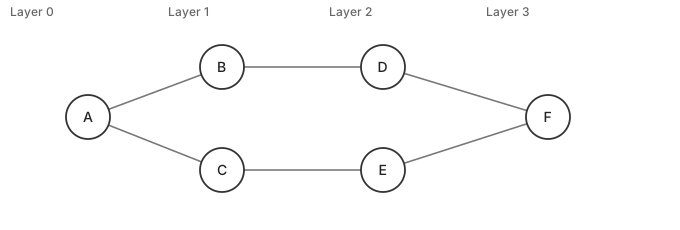
Breadth-first search: the queue invariant#
BFS explores vertices in nondecreasing distance measured in edge count. Start with the source at distance zero. Place it in a FIFO queue. Repeatedly remove one vertex, and enqueue each previously unseen neighbor at distance current_distance + 1.
from collections import deque

def shortest_hops(graph, source):
    distance = {source: 0}
    queue = deque([source])
    while queue:
        vertex = queue.popleft()
        for neighbor in graph.get(vertex, []):
            if neighbor not in distance:
                distance[neighbor] = distance[vertex] + 1
                queue.append(neighbor)
    return distance

sample = {'A':['B','C'], 'B':['A','D'], 'C':['A','E'],
          'D':['B','F'], 'E':['C','F'], 'F':['D','E']}
assert shortest_hops(sample, 'A')['F'] == 3
assert shortest_hops(sample, 'A')['C'] == 1
Proof idea: the queue contains discovered vertices in nondecreasing distance order. A first discovery through a vertex at distance d sets distance d+1. If a shorter path to that neighbor existed, its predecessor would have been processed at an earlier layer. Thus the first assigned distance is optimal for unit-weight edges [1].
Every vertex is enqueued at most once and every adjacency entry is inspected at most once. With adjacency lists, time is Θ(V_reachable + E_reachable) and storage for the visited set, distances and queue is O(V_reachable). Traversing every component yields O(V+E).
Depth-first search: stack and finishing order#
DFS explores one path as deeply as possible before backtracking. It can use recursion or an explicit stack. A visited set prevents infinite loops in cyclic graphs. DFS is useful for component discovery, cycle detection, topological ordering on DAGs and many graph decompositions; its traversal tree is generally not a shortest-path tree [2].
def dfs_iterative(graph, source):
    seen = set()
    stack = [source]
    while stack:
        node = stack.pop()
        if node in seen:
            continue
        seen.add(node)
        stack.extend(graph.get(node, []))
    return seen
Because neighbors can be placed on the stack before a vertex is marked visited, this variant may hold duplicate entries; complexity remains bounded by adjacency pushes, O(V+E). Marking on push avoids those duplicates but may change traversal order.
Selection and failure modes#
| Goal | Appropriate starting point | Caveat |
|---|---|---|
| Fewest edges from a source | BFS | Only for uniform/unit edge weights |
| Reachability | BFS or DFS | Respect edge direction |
| Explore dependency graph | DFS | Cycles must be detected separately |
| Lowest weighted cost | Dijkstra or Bellman–Ford | BFS is insufficient when edge costs vary |
State machines for DFS: detect cycles correctly#
For a directed graph, a single boolean visited only records discovery; it does not by itself distinguish a back edge to a current ancestor from an edge to a previously completed subtree. Use three colors: WHITE (unseen), GRAY (active in the current DFS recursion stack), BLACK (all descendants finished). During directed DFS, an edge from a GRAY node to another GRAY node identifies a directed cycle. An edge to BLACK is not sufficient. For undirected graphs, ignore the edge to the immediate parent when detecting a cycle [2].
Topological order exists only for a directed acyclic graph (DAG). Add each vertex to a list when its DFS exploration finishes, then reverse the list. Every directed edge u→v must place u before v in the reversed order, provided no cycle exists. This is stronger than merely observing an arbitrary traversal order.
BFS correctness and path reconstruction#
BFS computes distances measured in number of edges, because the FIFO queue processes layers. To recover a path, maintain parent[v]=u when v is first discovered from u. Starting from the target, repeatedly follow parents back to the source and reverse the list. An absent target is unreachable from this source; it does not prove that the graph has no edges or that other components cannot reach it.
from collections import deque

def path_unweighted(adj, start, target):
    parents = {start: None}
    queue = deque([start])
    while queue:
        u = queue.popleft()
        if u == target:
            path = []
            while u is not None:
                path.append(u)
                u = parents[u]
            return path[::-1]
        for v in adj.get(u, []):
            if v not in parents:
                parents[v] = u
                queue.append(v)
    return None

assert path_unweighted({'a':['b','c'], 'b':['d']}, 'a','d') == ['a','b','d']
assert path_unweighted({'a':[]}, 'a','z') is None
Proving resource bounds#
In an adjacency-list representation, every reached vertex is enqueued or recursively entered once, and every outgoing adjacency entry from reached vertices is examined once. This yields O(V_r+E_r) time and O(V_r) auxiliary state, where V_r,E_r describe the explored reachable subgraph. Recursion adds up to O(V_r) stack frames. For an adjacency matrix, testing neighbors can require scanning V columns per vertex: O(V²) in the full traversal. For BFS on weighted edges with weights 0 and 1, specialized 0–1 BFS exists, but ordinary FIFO BFS is not correct for arbitrary weights [1].
Verification and traps#
A graph may have self-loops, parallel edges, isolated vertices and disconnected components. State whether vertex labels absent from adj still count as vertices. Mark nodes when enqueuing to avoid duplicates. If you want a full-graph traversal, iterate over the known vertex set and launch another search from each unseen vertex. Never confuse tree edges (first discovery) with arbitrary graph edges: that distinction controls cycle reasoning. A useful test suite includes an empty vertex set, a single isolated vertex, a directed cycle and two disconnected components.
Exercises and verification#
- Add an isolated vertex
Zto the sample graph. It must be absent from distances starting atA. - Replace edge
A→Bweight 1 with weight 100 and add a two-edge route of total weight 2. BFS minimizes hops, not weighted cost. - For
V=1andE=0, BFS must return{source: 0}even if the adjacency map is empty.
Explain whether your input is a directed graph, how missing vertices are represented and which meaning of "shortest" your algorithm actually guarantees.