A replicated database or metadata service may need multiple machines to agree on one sequence of commands despite crashes and delayed messages. Distributed consensus provides a way to coordinate that decision while preserving a stated safety model. It does not make network partitions disappear, and it cannot ensure progress when too few nodes can communicate. Raft is a leader-based algorithm that decomposes this problem into leader election, log replication and safety restrictions [1].
Specify the fault model and the state machine#
Assume n nodes exchange messages across a network that may delay, duplicate or drop communication and may partition. Nodes can crash and later restart using durable state. Ordinary Raft is designed for crash faults, not arbitrary Byzantine behavior where a node lies or signs inconsistent information. A deterministic state machine applies commands in log order: equal initial state plus equal ordered commands yields equal results. External side effects require additional idempotency and transaction design.
A log entry contains a command and the term in which a leader created it. Terms act as monotonically increasing logical epochs, not synchronized wall-clock time. Nodes have follower, candidate or leader roles. A voter with a newer term can invalidate leadership assertions from an older term. Persisting current term, vote and log safely is necessary so restart does not undo promises that other nodes relied upon [1].
Why majority quorums intersect#
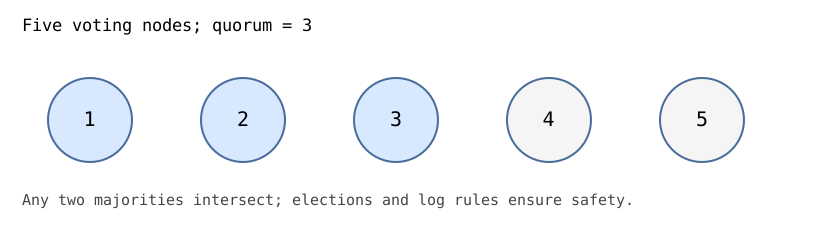
For n=2f+1 voting nodes, a majority quorum contains f+1 nodes. Any two quorums of that size intersect: (f+1)+(f+1) = 2f+2 > 2f+1=n. Thus they share at least one voter. For n=5, the majority is 3. If two groups each claim to have 3 distinct voters, they would need 6 voters, impossible. However, intersection alone is not sufficient to prove full Raft log safety: voting restrictions and log matching also matter.
from itertools import combinations

def majority(n):
    if n < 1:
        raise ValueError("positive voter count required")
    return n // 2 + 1

def majority_quorums(n):
    return [set(c) for c in combinations(range(n), majority(n))]

groups = majority_quorums(5)
assert majority(5) == 3
assert len(groups) == 10
assert all(a & b for a in groups for b in groups)
assert majority(3) == 2
This code enumerates quorum sets only and costs combinatorial time/memory; it is a teaching proof check, not a Raft implementation. Real membership changes require carefully chosen reconfiguration protocols rather than naïvely switching n or assuming a majority of the new set is automatically compatible with the old set.
Election rules and leader completeness#
When a follower does not hear timely leader communication, it may become a candidate, increase its term and request votes. Each node grants at most one vote per term, and a candidate must show a log at least as up-to-date as the voter's according to Raft's last-log term/index rule. This prevents electing an arbitrary stale node that lacks required committed entries. Randomized election timeouts reduce simultaneous candidacies but are not a guarantee of instantaneous election [1].
If two candidates compete, no one may gain a majority until timeout or partition conditions change. Election safety means at most one leader can be elected for a given term, under correct persistence and voting rules. In a split network, a node from an old term might still believe it is leader; it cannot commit new entries without a quorum under Raft's rules. A stale leader's own belief is not proof of authority.
Log matching and replication#
The leader appends commands to its log and sends AppendEntries to followers with the previous index and term. A follower accepts the extension only when its log matches at that preceding position; conflicting uncommitted suffix entries are resolved as the leader repairs that follower's history. This forms the log matching property: if two logs contain entries with the same index and term, their preceding entries agree according to Raft's safety guarantees [1].
A client can submit the same command repeatedly after a network timeout. Raft gives log-level ordering and replication, not automatically exactly-once business effects for retries. The replicated state machine should remember client/operation identifiers and previous results, or use another correct deduplication protocol, so a retransmitted payment request does not repeat a charge.
The subtle commit rule#
For an entry created in the leader's current term, once replicated on a majority, the leader can consider it committed under Raft's commit procedure. Entries from previous terms cannot be committed merely by counting replicas; they become committed indirectly when a current-term entry is committed according to the protocol. This distinction prevents a leader from incorrectly asserting safety when logs from older terms have complex divergence [1].
Consider a five-node cluster where a leader has an entry replicated to three nodes, then network partitions remove two nodes. The connected trio can still form a majority and make progress provided elections, logs and term rules allow it. A fragment of only two voting nodes cannot commit new entries, even if both remain healthy. Availability depends on reachable voting quorums, not just total CPU uptime.
Read consistency and linearizability#
A leader serving a read from its local state could be stale if it was partitioned and replaced by a new leader. Linearizable reads need extra checks ensuring the leader is current and that the state machine has applied committed entries sufficiently; implementations may use a quorum-based ReadIndex protocol or carefully justified lease strategy. Raft's replicated log by itself does not certify every arbitrary leader-local read as linearizable.
Client-visible completion also depends on durable persistence, command application and how the service associates the reply with a unique request identity. A replicated log protects ordering of entries under assumptions; it does not define business-side transaction boundaries, API authentication, network encryption or disaster recovery policy.
Failures, metrics and operational choices#
| Failure | Safety requirement | Availability consequence |
|---|---|---|
| Follower crashes | Preserve leader/committed history | Majority may still progress |
| Leader crashes | Elect sufficiently up-to-date replacement | Brief election interruption |
| Minority partition | No new commits without quorum | Minority cannot perform linearizable writes |
| Delayed old leader messages | Reject stale terms/conflicts | Temporary retries/confusion |
| Storage loses persisted vote/log | Raft assumptions violated | Safety may fail |
Monitor leader changes, term churn, failed append attempts, commit-index lag, applied-index lag, disk fsync latency and network delay. Timeouts that are too short relative to normal RPC and disk delays cause churn; too long delay failure detection. Use careful membership change procedures and disaster-recovery testing before assuming a replicated service is automatically safe.
The broader course on distributed systems at MIT develops replicated state machines, failures and testing as connected topics [2]. Related chapters: Database consistency distinguishes serializability from linearizability; asynchronous messaging studies duplicates and durable acknowledgment.
Exercises and verification#
- For five voters, list two majorities and show their intersection. For six voters, why is the majority four, not three?
- A leader has a majority-replicated entry from an older term. Explain why Raft requires special commit handling instead of just counting copies.
- Trace a five-voter partition into groups of 2 and 3. Which group can elect and commit, assuming correct logs and voting?
- Why can a former leader return a stale value even while its local log is internally consistent?
- Define a deduplication state entry for client C, request R and response X. Explain how applying the same command twice must preserve one business effect.